SILVER SPRINGS
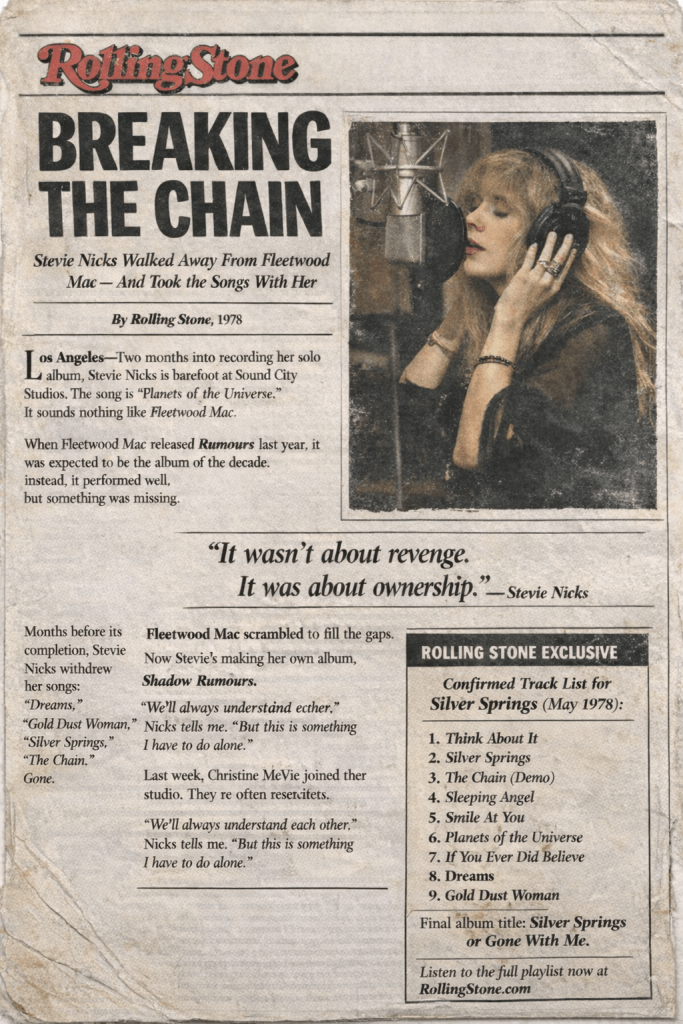
Stevie Nicks Walked Away From Fleetwood Mac — And Took the Songs With Her
By Rolling Stone, 1978
Los Angeles — Two months into recording her first solo album, Stevie Nicks is barefoot on the studio floor, shawl pooled around her shoulders, eyes closed as the tape rolls.
The song is “Planets of the Universe.”
It doesn’t sound like Fleetwood Mac.
It sounds colder. Wider. Less willing to resolve.
Behind the glass at Sound City Studios, producer Jimmy Iovine leans toward the console. Two young vocalists — Lori Perry and Sharon Celani — wait at a second microphone, ready to enter on her cue.
“Again,” Nicks says quietly. “But darker.”
They rewind.
When Fleetwood Mac released Rumours last year, the record arrived freighted with expectation. The band had survived romantic collapse, studio implosions and a recording process so meticulous it bordered on ritual. Industry observers predicted another cultural monument — something to sit alongside Hotel California and the disco surge currently dominating Los Angeles clubs.
Instead, Rumours performed well — platinum, respectable — but stopped short of myth. Critics praised its polish. Radio embraced its sheen. Yet something elemental felt absent.
Several things, in fact.
Months before the album’s completion, Stevie Nicks quietly withdrew her material from the track list. “Dreams.” “Gold Dust Woman.” “Silver Springs.” Her lyrical architecture for “The Chain.” Removed.
Fleetwood Mac scrambled. Additional Buckingham and McVie compositions were recorded to stabilize the album. The result was cohesive and elegant — but curiously restrained. A success. Not a phenomenon.
“It wasn’t about revenge. It was about ownership.” — Stevie Nicks
Ownership did not come easily.
Behind the scenes, Warner Bros. entered tense negotiations with Fleetwood Mac’s management over recordings already tracked during the Rumours sessions. Several of Nicks’ performances had been cut with the band’s full instrumentation. Contracts were parsed. Points recalculated. Lawyers circled.
The label’s position was clear: Nicks remained under the Warner umbrella. The masters belonged to the company. Fleetwood Mac could contest usage — but doing so would delay releases and complicate royalties.
In the end, pragmatism prevailed. The band agreed to compensation terms for select recordings and demos. Publishing splits were amended. Tempers cooled, not resolved.
“It was intense,” says one executive familiar with the talks. “But everyone understood the upside. If Stevie’s record hit, everyone benefited.”
Fleetwood Mac did not endorse the move. They complied.
In May 1978, Stevie Nicks releases her first solo album: Silver Springs.
Named for the song once cut from Rumours, the title functions less as grievance and more as declaration.
“If Rumours was about staying,” Nicks says now, seated cross-legged between takes, tambourine near her boots, “this one is about leaving.”
The sessions for Silver Springs feel immediate. Early takes are preserved rather than polished away. Harmonies rise without excessive smoothing. Lori Perry and Sharon Celani do not simply back Nicks — they encircle her, their voices forming something closer to invocation than support.
On “Think About It,” originally written during Fleetwood Mac’s unraveling, the lyric now reads as internal reckoning. On “Smile At You,” she delivers a sharp rejoinder to Buckingham’s defiance, not with theatrical fury but with precision.
“You can’t be angry and poetic at the same time,” she says. “You have to decide.”
She doesn’t.
“Silver Springs,” released as the album’s first single, has already surged up the charts. Freed from exclusion, the song lands as both heartbreak and indictment. Radio has embraced its clarity.
“Dreams,” which she insisted on retaining, leans deeper into its R&B undercurrent. “The Chain,” rebuilt from its skeletal demo, feels haunted rather than triumphant. “Gold Dust Woman,” which closes the album, abandons polish for menace.
And “Planets of the Universe,” shaped in part by Iovine’s instincts, stretches outward — less breakup song than cosmic recalibration.
“It’s about scale,” Nicks says. “The emotional kind.”
There is no public hostility between her and Christine McVie. Last week, the two met for lunch in Beverly Hills — no press, no spectacle. They spoke for hours.
“We’ll always understand each other,” Nicks says later. “But this is something I have to do alone.”
Fleetwood Mac continues forward, reshaped but intact. So does she.
Outside the studio walls, 1978 feels unsettled. Disco pulses through Studio 54. Punk detonates at CBGB. The Eagles dominate FM radio. Patti Smith and Debbie Harry are expanding the vocabulary of female presence in rock.
In that atmosphere, Nicks’ departure reads less like fracture and more like inevitability.
Work has also resumed on the long-gestating Rhiannon film Nicks optioned in 1976. With a solo career now fully underway, the Celtic-inflected fantasy feels less like a side project and more like a blueprint.
“It’s always been bigger than a song,” she says. “It’s a world.”
That world now has a name.
Silver Springs is not a compilation of leftovers. It is not retaliation. It is a reframing.
Where Fleetwood Mac sought cohesion, Nicks leaves seams visible. Where the band stabilized, she destabilizes.
Back in the control room, playback of “Planets of the Universe” fills the studio. Lori Perry and Sharon Celani sway slightly as their harmonies rise and dissolve around Nicks’ voice.
Fleetwood Mac’s Rumours may remain a respected record of the decade.
Silver Springs might redefine it.
“It’s not about leaving,” Nicks says quietly as the tape slows to a stop. “It’s about beginning.”
You can listen to both playlists & view the episode on our YouTube channel.
 The Generic, Non Specific Stevie Nicks Podcast
Genius!
LikeLike